The Art of Connection
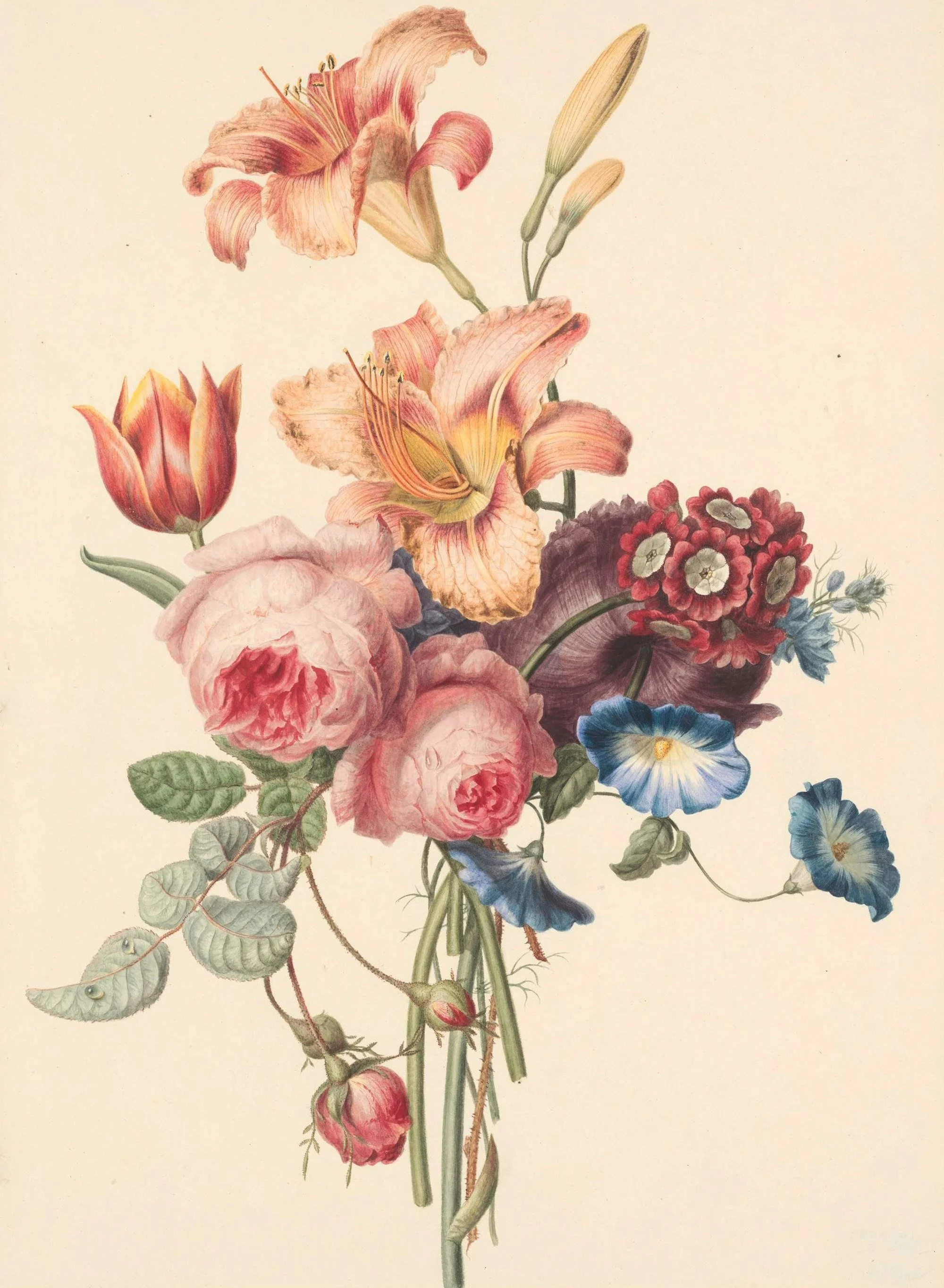
Photo by Europeana on Unsplash
August 29, 2024
The waning crescent moon is larger than a sliver, more like a wide smile. This morning the moon-smile shone brightly from a clear spot between clouds when I walked out to my car in the early morning dark. Then it slid partly behind a cloud, then disappeared leaving only its soft glow. Then a corner of the smile emerged and this back and forth continued, a slow dance between the moon-smile and the clouds.
As August ends, the sky is dark when I leave my house at 5:30 am, and the moon is high in the eastern sky. An hour later the sky is fully light, though headlights are needed for being seen if not for seeing on the road. The lowest clouds still wear the soft peach and plum colors of the dawn that happened about 20 minutes ago.
By the end of August I’ve had it with summer and I’m looking toward September and the promise of autumn with its cool, crisp energy. This is fantasy, of course. Most of September here remains stubbornly summer, though there are days of respite. We’ve even had a few of those days this month, though not now. Extreme heat and humidity have returned, smothering any useful energy.
Two August events stand out for making it worth the effort it’s taken for me to trudge through the rest of the month.
I went to music camp.
This is a common summertime activity for youngsters who are serious music students; one of the prestigious and venerable camps is Interlochen Center for the Arts, in Michigan. Every summer from rising 8th grade through high school graduation, I spent two weeks at a non-prestigious but excellent music camp at Northern Arizona University.
The event I attended this month, at a local music school, was billed as a retreat for adult players of stringed instruments. Eleven of us—mostly violinists, a few cellists, and one double bass player—spent three intensive days learning and rehearsing music for chamber ensembles (we each were placed in one of three small groups) and the large ensemble (all of us, plus a couple of teachers). The retreat theme was Broadway, and all the repertoire was show tunes.
This description, which tries to orient you to the basic reality of the thing, doesn’t at all convey what pure, nonstop FUN it was. That’s why it felt like music camp.
There were three teachers, all excellent performers and teachers—two different skill sets. As the retreat was for beginning to intermediate players, we all were at similar levels of advancement. Most of us had begun learning to play our instruments as adults and had little or no experience with ensemble playing. (At the music camps of my youth I played piano and clarinet. I started taking violin lessons ten years ago, when I was 59.)
The daily schedule included rehearsals for the small and large ensembles, plus presentations by the teachers on topics such as the history of Broadway musicals (“From Vaudeville to Hamilton”) and “Performance and State of Mind,” a session led by Agata—pronounced AH-ga-tha with a very soft th sound; the English version is Agatha. A professional solo violinist for many years, she is the concertmaster of a prestigious orchestra in Washington, DC. She started her talk with a story.
“I had just met my mentor for the first time,” she said. “I asked him, ‘I have terrible performance anxiety. I get on stage in front of an audience, and I’m so nervous I can hardly play. What should I do?” He looked at me and said, “Don’t be nervous.”
What?? “Just don’t be nervous. It’s a choice. You can choose to be nervous and tense and stressed, or choose to be confident and relaxed.”
I thought about that story for the rest of the retreat, and I’m still thinking about it. I’ve heard the same thing told in different ways and under many circumstances. It’s not a widely accepted idea, this choice about emotional and physical reactions that feel like forces completely outside my control. There’s a range of opinions, from mindfulness, which trains us to choose to be fully present and curious instead of reactive or overwhelmed by whatever is happening—a version of Agata’s mentor’s “You can choose …”—to the theory of neuroscientist Robert Sapolsky that free will, aka choice, simply doesn’t exist.
“We are nothing more or less than the cumulative biological and environmental luck, over which we had no control, that has brought us to any moment.”
I get what Sapolsky is saying and I think it’s true to a degree, but I can’t fully accept the nonexistence of choice, maybe only because of the moral consequences it suggests. Or maybe because it just doesn’t make sense in everyday life.
The thing is, how do I act on choice when my lifelong belief is that I have no choice? How does one just do it?
Agata told us that studies have shown that the adrenalin output before a performance can equal that upon seeing a tiger in the jungle. She then gave us some mental and physical strategies for discharging the adrenalin. I can choose confidence over nervousness because self-confidence comes from knowing that I have done the work, practiced, and prepared as best I can.
Self-confidence—“You have done the work”— is different from self-esteem, which is the feeling I get from others’ evaluations of me, real or imagined. Do I really believe that I am enough? Well, no. What can I do to change that?
Henry Ford said some version of, “If you think you can or you can’t, you’re right either way.”
“If you stop trying to make yourself more than you are, out of fear that you are less than you are, whoever you really are will be a lot lighter and happier and easier to live with, too.”
The physical methods Agata suggested for releasing adrenalin and relaxing involve simple technical changes that give profound results. For instance, I get quite tense about my bow hand position. I know what is correct, but I also know that the whole point of correct position is keeping the bow hand relaxed and flowing, which is hardly ever my experience.
Agata suggested that I shift my attention from the small motions of my fingers to the larger motion of my arm. I tried this and it worked, and continues to work whenever I remember to do it. As I focus on my arm drawing the bow down and up, my hand automatically relaxes.
Another reason to choose confidence instead of anxiety, Agata said, is, “It’s not about you. The artist is just the channel between the composer and the audience. Remove the obstacles.”
In other words, I don’t get to be scared. My nervousness is an obstacle.
To students who claim to perform the music as they feel it, she says, “No, it’s not what you feel, but that you play so that they feel.” The time to be a virtuoso is when we are alone in our practice studio. “At home practicing, we are creative, exploring, emotional,” she said. “With an audience, just do your job.”
I thought of that when Agata offered to play the first violin part with me, for a difficult piece with my quartet. At first I asked her for a little time to consider it. I wanted the challenge and, yes, the potential triumph, of playing the part well by myself. But Murphy’s law of performance is constant: anything that can go wrong will go wrong. My ego wanted the chance to shine, but I needed to escort my ego gently to time-out and do what would serve the music. I gratefully accepted Agata’s offer, and exchanged stress for joy in the playing.
I visited an art museum.
One thing that can happen when you publicly declare your intention to do something is that your local friends step up to help. After I wrote in my midyear report that I had visited only one of my intended four art museums and galleries, my friend Sandra, an artist and creator of handmade paper, suggested we go to the Phillips Collection in Washington to see a special exhibition that is closing in September.
When the day came for our visit, it turned out to be one of those respite days I mentioned—sunny and cool with low humidity, making the trip downtown by Metro and walking a pleasure.
The exhibition, titled “Multiplicity: Blackness in Contemporary American Collage,” comprises nearly 60 works by 49 artists. We spent close to two hours among these works of collage, made from an amazing variety of materials including pieces of paper, photographs, fabrics, sequins, and salvaged objects. The artistic techniques and subjects, according to the exhibit’s promotion, include “fragmentation and reconstruction, shared history and memory, cultural hybridity, gender fluidity, and notions of beauty.”
One reason I seldom go to museums of any kind is that I find them sensually overwhelming and soon exhausting, and I don’t learn much from them. But walking around and viewing the art with Sandra reduced my overwhelm to a tolerable level, and her companionship and emotional support made the experience enjoyable.
Seeing the works of art and reading the accompanying descriptions made for an excellent and even educational day, but what turned this excursion from a flat, good-for-me sort of thing into a chance to stretch and even dance a little outside my assumed limits was being with my friend.
Surrounded by fine art, talking about the art and other topics that came up, later having lunch and sharing what’s going on in our lives, adding new pieces to our friendship collage—all of this was the surprising joy of August.