Tjikko in Spring
April 25, 2025
One recent afternoon, Tjikko and I walked along a path across the street from a community college. I was tired, my perpetual state these days, and my mind was lost in a spiral of discouraging thoughts.
I love this dog so much, but he’s exhausting. Should we have gone for a slightly less active breed? Maybe a female would have been a bit more manageable?
Then I saw a woman walking toward us, far enough away that I could consider my next step. Generally I would cross the street as quickly as possible, because Tjikko is so exuberant about wanting to meet people and even more so with dogs. And he’s strong and very hard to manage. (See spiral of discouragement, above.)
The woman was alone. That morning, I had taken myself out of the house for a long break, so I still had some store of patience. For the record, Tjikko is being trained. He knows certain commands and sometimes obeys them, given enough treats. He usually will walk on my left, the side where treats appear, and he’ll sit on command as long as the distractions are minimal. Lately his behavior has improved a bit with people, not so with dogs.
I decided it was worth the risk to stay on the path. My intention was simply to guide Tjikko, gently and firmly, but as we passed the woman and I greeted her she asked, “Can I interact with your dog?”
I nodded. “Sure.”
She approached Tjikko with all the right etiquette for meeting a dog. He strained against his harness, his puppy behavior exclaiming, “I love you!! You’re my new best friend!!”
The woman bent over him and softly ruffled his shoulders and behind his ears, while he danced joyfully, wiggling his butt and reaching out his tongue to lick her face.
“He’s so beautiful!” the woman said, “the most beautiful dog I’ve ever seen! I see you walking him every day. You walk right past my house. I’ve been watching him grow. What’s his name?”
I told her, and then she and I exchanged names. Christy lives about a block up the street from me. I hoped she hadn’t observed any of my less patient moments with Tjikko. As we parted, she actually apologized for interrupting our walk.
“Oh, it’s no problem at all,” I assured her. “I really enjoyed meeting you.” As we parted (Tjikko amazingly calm for a change), I wanted to call out after her, “My new best friend!! I love you!!”
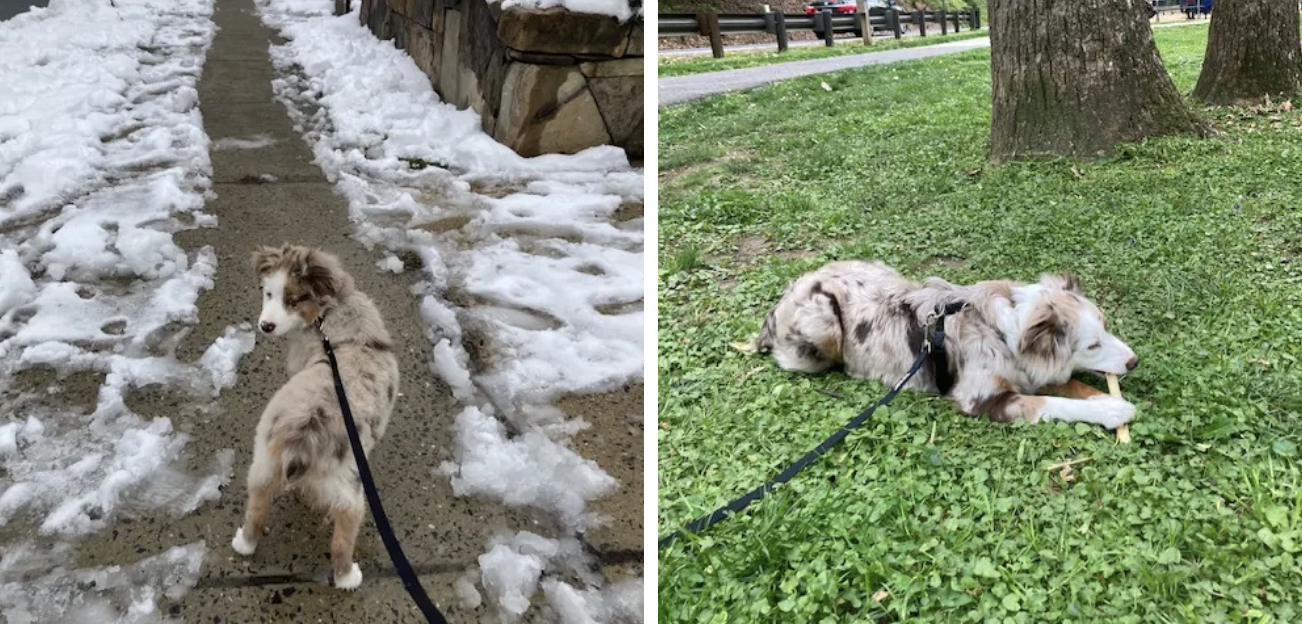
Springtime with Tjikko is certainly different from those early winter days. It was December 21st when we welcomed the 9-week-old Miniature Australian Shepherd into our home, and the next three months turned out to be the roughest winter this area has seen in many years. Some of the spring changes are welcome—the weather, for one—while others are more challenging. Same with Tjikko’s growth and development: it’s been fascinating, fun, and a continual source of problem-solving opportunities.
Early spring was lovely. Wintry cold lingered but somehow the mid-30s felt softer when accompanied by bright sunlight and fresh green leaves. Soon there came the typical lurching between winter and summer; temperatures can be in the mid-80s one day and drop 40 degrees the next. When oak pollen season began, I thought we might get through it easily because the air was still cold, so windows stayed shut, and there was rain.
Alas, the weather changed, several days of summery heat and humidity ensued, and there’s been no rain for weeks. Everything is covered in greenish yellow dust—and I mean everything. The layers indoors are just thinner than outdoors.
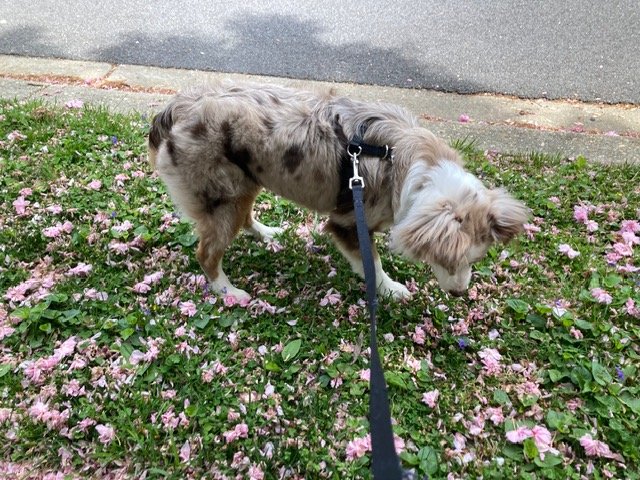
The blossoming trees, too, fluffed out with soft shades of pink and white in early spring. Now most of the blossoms have fallen, carpeting the sidewalks and the ground between a sidewalk and a lawn.
I searched for the name of that strip of ground and learned from various sources that it has dozens of names, depending on the region, including verge, grass strip, nature strip, curb strip, etc. In my neighborhood, some of the strips are grassy, others mostly hard, dry dirt. All are covered with not only tree blossoms but also nuts, seed pods, mulch chips, clumps of dirt and mown grass, and, most annoying now, oak pollen tassels—scientific name “catkins”—which can gather into baseball-size clumps.
As I’ve mentioned in previous chronicles, Tjikko loves to pick up, chew, carry, or eat anything from the ground, including those disgusting clumps of catkins, and he’s now expert at grabbing something while I’m hurrying him past a landmine of detritus. If the thing is natural and I can see it, I’m usually okay with it. For the rest—the unknown substance he’s chomping on—I depend on one of the few commands he obeys nearly every time, which is “Trade.” He drops the object, if it’s not too sticky or fuzzy to drop, and accepts a treat in return.
Last Monday I drove with Tjikko the mile’s distance between our house and Sligo Creek Parkway, a long, narrow urban forest with a walking/biking path along the creek. The weather was perfect—about 60 degrees and cloudy, after several days of summer-like heat and humidity.
This was Tjikko’s first visit to a natural waterway; the small creek, rather low now (no rain lately), in some spots appeared stagnant but in others flowed gently.
I walked him down the bank for a look, and he wagged his tail and leaned out toward the water. Someday I’ll let him swim, though not today, and probably it will be in a lake.
At first things went well as we walked, me on the paved path, Tjikko exploring the ground alongside, nature’s own snuffle mat. He was interested in the people passing by but remained fairly calm, not lunging forcefully to greet them. I was grateful for the low fence between the path and a playground full of children.
This relatively easy stroll continued for about half an hour, until Tjikko started to tire and to be overstimulated by the distractions of walkers, runners, cyclists, dogs and their handlers. He became more determined in pursuit of his own goals, lunging this way and that, crossing in front of or behind me, resisting all my efforts to assert my “leadership.”
Finally, he went into a zoomie—the scientific term is “frenetic random activity period (FRAP)”—running at top speed in circles around me. I used all my strength to hang on to the leash, squatting low and turning with his circling, until finally I sat down in the grass, maybe one second before I would have been pulled or knocked over.
Eventually he slowed down enough to be controlled, and I confess that I yelled at him—not too loudly, as I didn’t want to attract attention to this “leadership” fail.
We both recovered, and my next act was to catch him doing something good and give him treats and praise. Not that I think he’s that eager to please me, but it helps with the recovery.
We walked the mercifully short distance back to the car, Tjikko straining at the leash.
On Wednesday morning I again invited Tjikko into the crate that lives on the back seat of my car. We drove a mile, this time to my friend Trish’s home. The three of us walked through her neighborhood of mid-sized houses with plentiful trees and dense green front lawns along wide streets where hardly a car passed by at this early time of day.
This was our second outing with Trish. The first, a short walk in my neighborhood, had been predictably challenging. After all, to a half-grown puppy, a teenager, the first experience of anything is an irresistible invitation to follow one’s own nose and ignore the “leader” on the other end of the leash.
But after the first time, Tjikko settles into his normal, opinionated puppy behavior. Thus our Wednesday morning walk proceeded fairly smoothly, and I could enjoy the conversation with my friend, paying only the normal diligence to his whims.
Here in the Northern Hemisphere the plants continue to sprout, grow, blossom, fade, and fall, as this part of the world cycles through its flowering season. Now the azaleas are at their peak, filling lawns and parks with vibrant shades of pink, purple, and white.
The animals, too—all of us—progress through our developmental seasons. Here I am, moving toward my own metaphorical winter, learning to share leadership with my companion in his spring, who constantly reminds me that life in every season is for “exploring, experimenting, being curious.”
Those are the words of Dot Fisher-Smith, of Ashland, Oregon, in a short video produced by the organization Reflections of Life. I found this video in the April 10th post by Diana Butler Bass, which she begins with this:
Awe and wonder are key to a life of joy — we know that. In recent years, researchers have also discovered that people who experience wonder are also more generous, thankful, and compassionate. As it turns out, awe inspires us to do good, serve others, and work for a more just world. — Diana Butler Bass, Wonder
Dot Fisher-Smith speaks of learning to play now, in her tenth decade, much more than she played as a child. She’s my new leader and mentor as I grow into my old age. I leave you with her words.
I don’t want to have just visited this world, so I’m living as fully as I can with what I have. I want to be a child of wonder and astonishment.