Tjikko the Teenage Ninja Aussie
March 14, 2025
Hello dear readers! Some of you are fairly new to this space—welcome! I’m so happy you’re here. This post is the latest in an occasional series of news about our puppy, Tjikko. You can read about his arrival (and how to pronounce his name) here, and subsequent chronicles here, here (bottom of the post), and here.
Peace and blessings to all of you.
noun: ninja
a person skilled in the Japanese art of ninjutsu.
informal
a person who excels in a particular skill or activity.
noun: ninjutsu
the traditional Japanese art of stealth, camouflage, and sabotage, developed in feudal times for espionage and now practiced as a martial art.
The number 21 is significant in Tjikko’s life so far. He was born October 21, 2024. He came into our home December 21. Next Monday, he will be 21 weeks old, and on March 21, the day after the Spring Equinox, he’ll have lived five months on earth and one full season with us. At his last checkup the vet said he’s now a teenager. I believe it. He’s also a ninja, skilled in the art of ninjutsu as defined above.
Back in the aughts, when I was leading parenting classes with the Parent Encouragement Program (PEP), I became familiar with the work of Dr. Edward Hallowell, a specialist in the treatment of ADHD. Something he would say in his workshops, which is now quoted at the bottom of his website Home page, is, “ADHD is like having a ferrari brain with bicycle brakes. Strengthen the brakes and you have a champion.”
ADHD is like having a ferrari brain with bicycle brakes. Strengthen the brakes and you have a champion” — Ned Hallowell
That quote comes to mind often in the Puppy Kindergarten classes Tjikko and I attend on Monday mornings. Not that I think Tjikko has ADHD—though I wouldn’t be surprised if it’s diagnosed in pets these days. He does show some of the characteristics, such as a tendency to hyper-focus on his own goals.
But what makes me think of the quote is that it expresses the difference in energy and activity between Tjikko and all the other puppies in the class. With their normal puppy, bicycle-level energy, they bounce around some, bark occasionally, and mostly sit quietly next to their handlers, maybe chewing their shoelaces.
Tjikko runs into the training center’s open, showroom-size space as fast as his leash will allow, straining forward, tail wagging furiously, eager to greet all the dogs and people. He doesn’t bark as long as he’s busy—during play time or when we’re practicing a command. But whenever he doesn’t have a job to do, he barks loudly and persistently until one of the training assistants comes over and sits next to him, feeding him tiny bits of cheese as he lies down and happily snarfs up the treats.
Your Dog’s Friend is the name of the local nonprofit that offers a variety of classes where certified trainers use positive, reward-based methods to train dogs and educate and support their humans. You sign up for a certain start date but the classes are continuous, so at any given class there might be new puppies along with the repeaters.
We’ve had four classes so far, and each has had a puppy “graduate” at the end of the session. The next series is Puppy First Grade, for the ambitious.
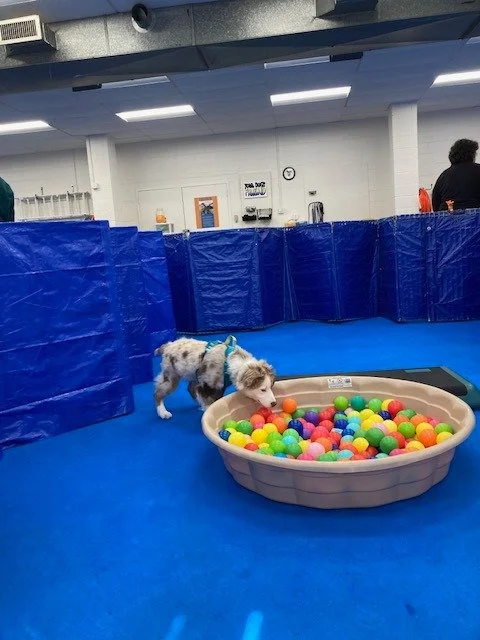
Each of Tjikko’s classes so far has had between seven and nine puppies. Socialization is emphasized because puppies need to learn to play and get along together, so the first half-hour is play time. The trainer and three assistants arrange the space using movable dividers that are about waist-high to the humans. Most of the dividers are solid, blue plastic, but some are open-frame wire panels that can be set up to give a new or shy puppy a safe enclosure that allows them to see the action.
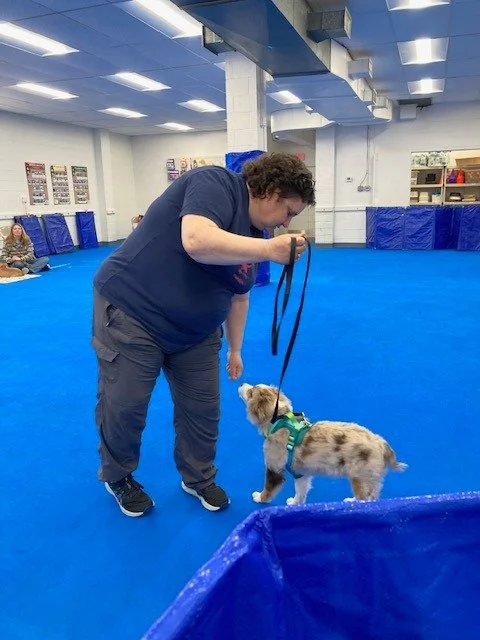
The trainer assigns puppy playmates according to their size, experience, and personality. During the play time the trainer and assistants are on the floor, monitoring the play. Any puppy who is a little overwhelmed is switched to another group. At various classes Tjikko has played with one, two, or several others.
I tried to add a short video here, but Substack tells me the image is too large. It’s almost impossible to take still photos, but here’s one of Tjikko with the trainer, who is demonstrating a command with him.
I love these classes not only for what I’m learning about training, but especially because of all the running and active play, which is great for discharging his energy. By the time we get home he’s ready for a long nap.
It’s a time investment, the 90-minute class plus an hour’s round-trip commute. But the return on investment is high, so we’ll continue with First Grade and I’ll probably add some Puppy Party classes, offered several times a week, which are an extended version of the free play part of Kindergarten.
I must keep in mind that managing Tjikko at home probably takes more time than the class and commute. This is concerning, and I wonder how people keep highly active dogs, especially those of the herding breed group, including Miniature Australian Shepherds,* sufficiently exercised and gainfully employed in the suburbs, where generally there are no sheep or goats to herd.
Tjikko’s primary exercise at home is walking, and we do a lot of it. Spring is on the move, just in time, because his energy increases as he grows. Most days, between the two of us resident humans, he gets five or six walks, each a half-mile to a mile, or 20 to 40 minutes, depending on his pace, which varies. We’re renovating our backyard to make it suitable for him to run freely, but it will be a couple of months till it’s ready.
Walking Tjikko is neither a relaxing stroll nor a straightforward jog. Occasionally he’ll amble along sniffing the ground, which is appropriate behavior and easy for the one holding the leash. But on most walks his main goal is to pick up and carry everything in his mouth. Sticks large or small, wood chips, small rocks, and leaves are some of the natural objects, but he seems to prefer things not found in nature: pieces of paper, a small coil of wire, green fuzz (maybe a packing material?), tissues that he chews into bits.
I’ve learned to tolerate most of the natural objects. After all, if he has a wood chip or a leaf in his mouth he can’t pick up anything else. But my relief is short-lived; he carries any one thing for only a few yards before he drops it and grabs the next thing. He’s especially attracted by contrasting colors, which explains the tissues and fuzz.
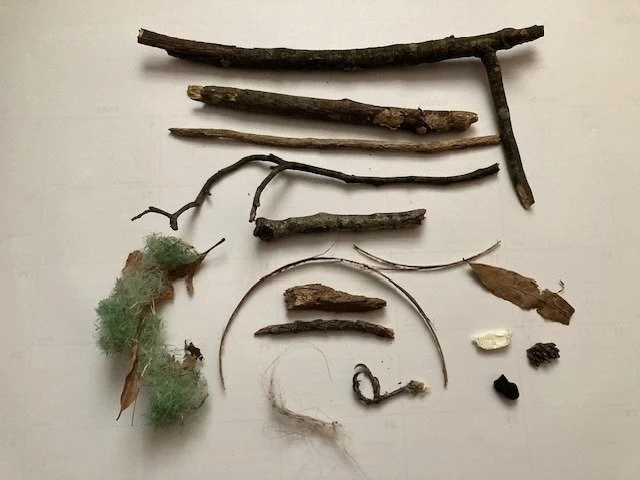
Actual objects Tjikko has carried on recent walks.
Actual objects Tjikko has carried on recent walks.
I’m just starting to train Tjikko to walk on a loose leash, which is not necessarily at my left heal but also not straining at the leash or running forward and then backward, or suddenly jumping across my path. I’ve learned to be mindful of every step, so as not to trip over him or get the leash wound around my ankles.
And then there are the other dogs out there, walking with their handlers. Tjikko’s instinct is to herd anything that moves: creatures that walk on four legs, or two, or no legs, like piles of dry leaves scudding across the sidewalk on a windy day.
This 10-minute video on YouTube, titled “10 Things Only Australian Shepherd Owners Understand,” confirms everything I’ve learned so far about Tjikko. No. 1 is “Aussies have an ‘I can herd anything’ instinct.” The narrator tells us that “the herding instinct is deeply ingrained in their genetics, so they have a strong desire to be in control. Without animals to herd, they may try to control you. … As their owner, establishing yourself as the pack leader early on is important to prevent them from taking over the household.”
I’m working on it.
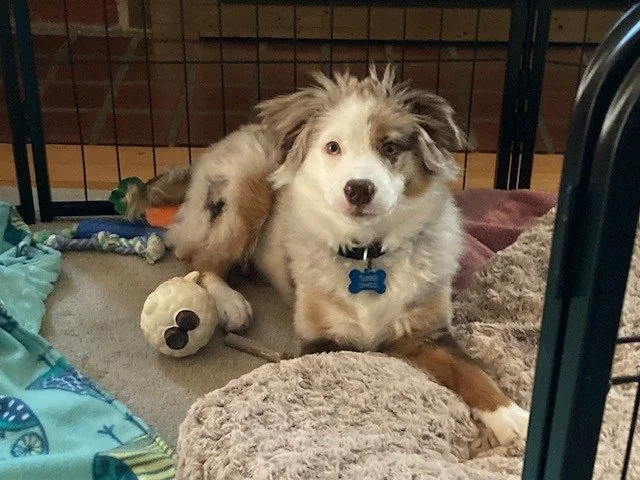
No. 5 is “Aussies have a never-ending desire to explore and discover new things.” That section of the video (4:50) actually shows an Aussie pulling the toilet paper from the roll! I reported this exact behavior in an earlier chronicle, and our teenage ninja repeats it whenever the bathroom door is left open or even closed but not securely latched. Which means, he’s checking that door.
In No. 9 I learn that “Aussies are renowned for their versatility” and they are highly trainable for various roles. For example, “their affectionate and compassionate nature makes them excellent therapy dogs, providing comfort and emotional support to those in need.” Whew. Maybe I won’t have to find a herd of sheep.
*The Australian Shepherd breed actually originated in Europe, with Basque shepherds bringing them along during their travels to Australia. The Mini Aussie, also called Miniature American Shepherd, was developed in California during the late 1960s.