Climbing in Wonder
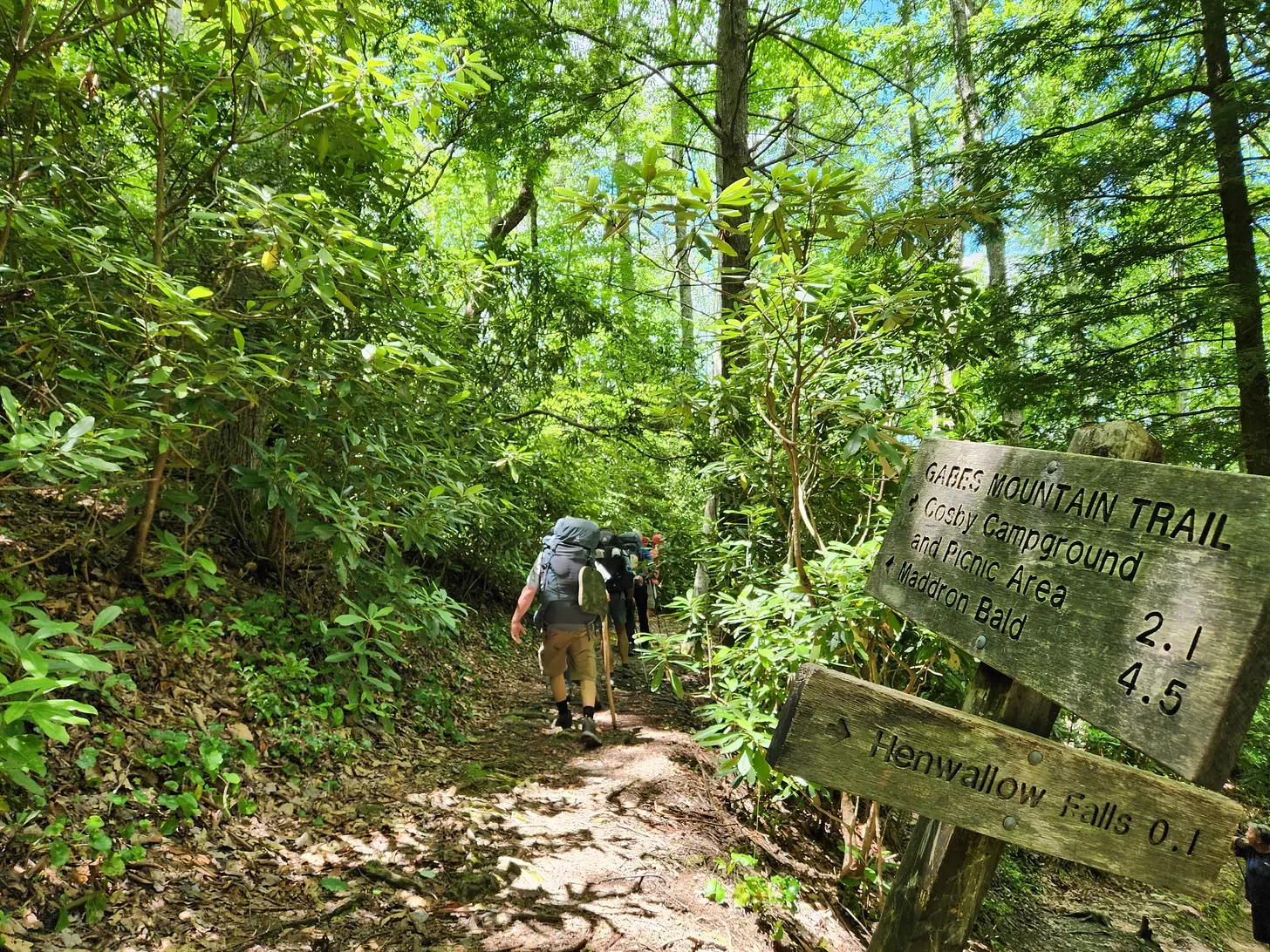
Photo by Lily G
July 01, 2024
Joy is a topic I keep running into, as I scroll through email newsletters, podcast feeds, news articles and book reviews. Maybe it’s because, as suffering and anxiety threaten to overwhelm us worldwide and within our communities, we need to focus more intently on what the poet and essayist Ross Gay calls “adult joy.”
Last week Catherine Price’s newsletter featured her video chat with Gay, subtitled “Join me and the author of The Book of Delights for a conversation about delight, wonder, and ladybugs.”
And a couple of weeks before that, On Being with Krista Tippett replayed her 2019 interview with Gay. In the introduction, Tippett says:
“Starting with his cherished essay collection The Book of Delights, he began to accompany many in an everyday spiritual discipline of practicing delight and cultivating joy.”
I’m still rather inconsistent with that discipline, and also with meditation, gardening and all of the practices that are supposed to slow me down and help me attend to delight and joy.
“We are good at fighting, as [Ross Gay] puts it, and not as good at holding in our imaginations what is to be adored and preserved and exalted — advocating for what we love, for what we find beautiful and necessary.”
When Tippett’s podcast episode and accompanying newsletter appeared, I was looking for delight and joy while climbing past massive trees and their moss-covered understory in Great Smoky Mountains National Park. First delight: learning that this region is a temperate rainforest and one of the most biodiverse temperate regions in the world.
I had signed up for this four-day backpacking trip with the Flagstaff-based company Wildland Trekking, and it was quite a treat to have it all planned and guided and the food bought, packed and cooked for me. The experience met or exceeded all of the company’s promises and gave me everything I hoped for, plus unexpected joys and delights.
The trekking group
We met in Asheville on the afternoon of June 9, six of us and our Wildland Trekking guide.
Ken & Steve – friends, age 50-ish, who live in Los Angeles; Ken also lived ten years in Phoenix (where I grew up)
Lily & Dallas – 40-ish couple living in Texas; Lily works in health care administration, Dallas in IT
Gary – lifelong Michigan resident, 65; worked for Herman Miller as a machine repairman until laid off in 2002; then retrained for electrical work. His wife and 13-year-old granddaughter stayed in Asheville while Gary hiked.
Me – age 69, the eldest and slowest of the group—characteristics not necessarily related
Francisco – trail guide, 39; lives in Asheville
Day 1
After loading our backpacks into the Wildland Trekking van, Francisco drove us about 90 minutes to a campground. From a giant cooler-on-wheels he brought out bread and various deli meats and cheeses, sliced tomatoes and lettuce, condiments and bags of chips, and we made our lunches to take on trail.
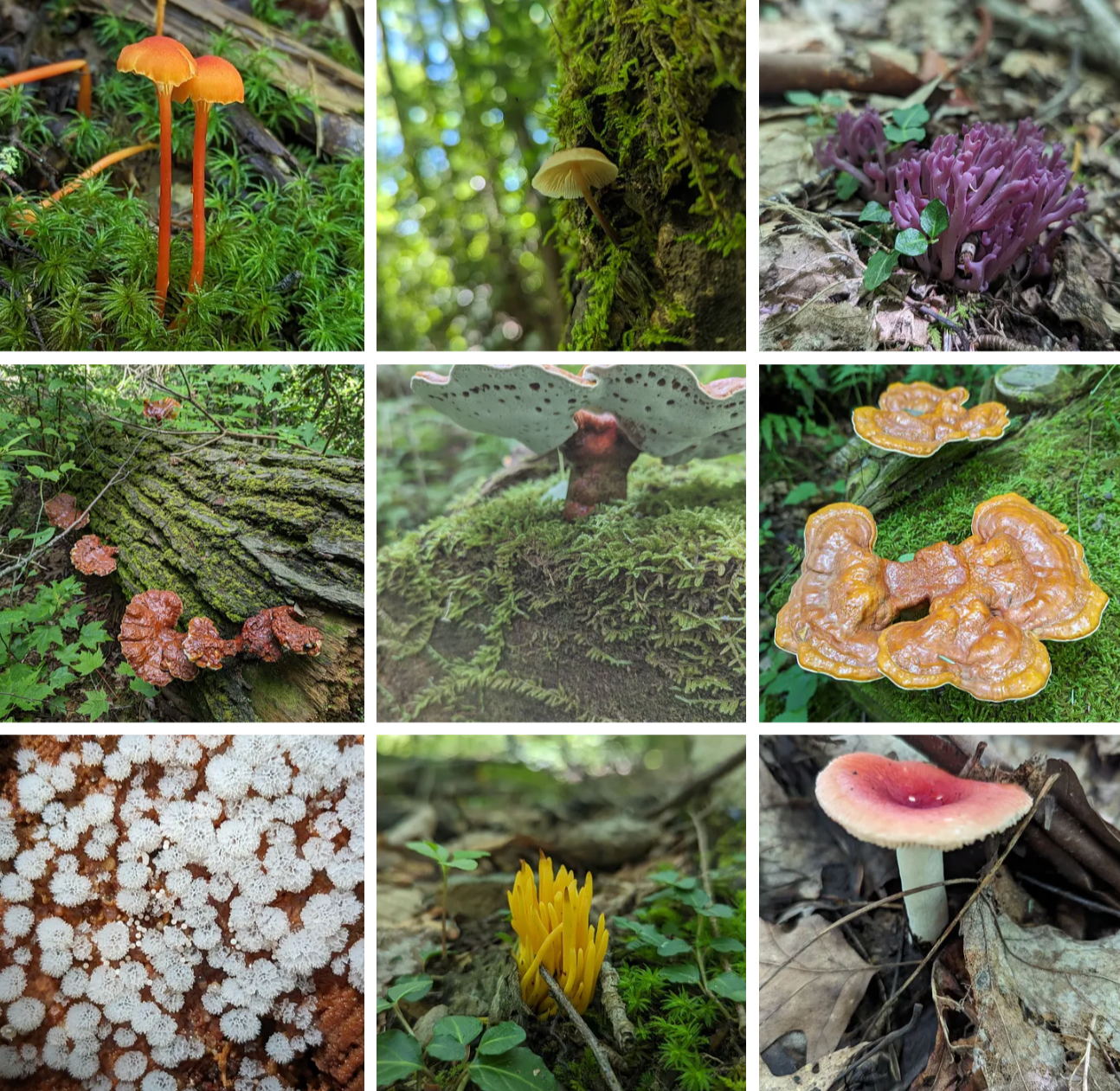
Photos by Fransisco M and Dallas G
We started climbing Gabe’s Mountain toward Hen Wallow Falls, which is on a spur trail going sharply downhill. Fransisco stayed with our backpacks and sent us down the spur to eat lunch at the spectacular, 90-foot waterfall. I went most of the way down, but, not knowing how much more I still had to go, and already feeling the effects of the morning’s hike, I decided that seeing the waterfall wasn’t worth continuing downhill (and having to climb back up) so I returned to the main trail to eat my sandwich with Fransisco.
Instead of the Big Delight of viewing a 90-foot waterfall, I had the gentle joy of chatting with Fransisco, who handed me two tiny quartz rocks he had sifted from the soil where he sat. Another small delight: thanks to his pointing it out, I began to notice the quartz—white rocks peeking out of the soil everywhere along the trail.
The rest of the group eventually returned and we continued climbing through the towering hardwood trees and the brush and vines crowding the edges of the trail. Along the way Fransisco stopped occasionally to photograph mushrooms of all sizes, shapes, and colors. While the photographers among us dropped to the ground, Fransisco identified the mushrooms and told us what they do.
The visible stem and cap, I learned, is only a bit of the mushroom, the reproductive part that disperses its spores. Most of the fungi is underground and can extend over acres. This underground network uses enzymes to “digest” substances that become its food as it breaks down dead plants and recycles their nutrients.
Other ground-level delights included snails, salamanders and dragonflies.
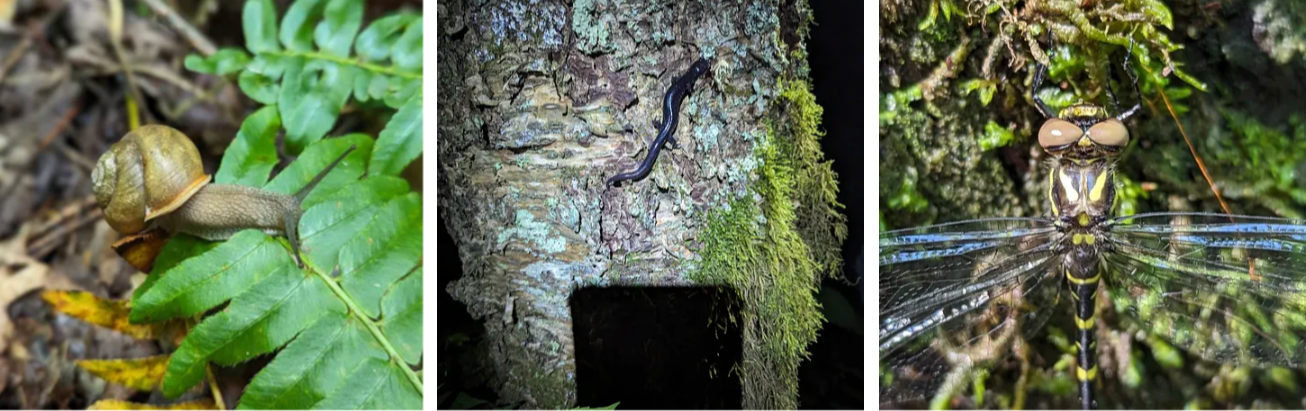
Photos by Fransisco M and Dallas G
We arrived at our campsite at around 4:30 and set up our tents while Francisco did the camp chores. This delight alone would have made the trip worth the price. When you’re backpacking on your own, at the end of a day spent climbing mountains with at least 30 pounds on your back, you then have to filter water, unpack food and cooking gear, prepare the food and, later, bear-proof the food and all other “smellables” for the night. Fransisco did all those chores and built a lovely campfire, too. The more energetic ones in our group helped gather kindling.
And the dinner Francisco cooked was scrumptiously better than the usual camp fare of reconstituted dried beans, rice or pasta and veggies, flavored to your taste by the liberal application of hot sauce. None of that for Francisco. For his dinner of curried tempeh with veggies, he first heated a pot of water to boiling, removed it from the camp stove and added quick-cooking rice. Then in a pan coated with sesame oil he sautéed chopped fresh broccoli, green onions, peppers, carrots and green beans, plus the tempeh, along with minced cilantro stalks and ginger, then added coconut milk and curry for the sauce. All this was served over the rice, with chopped green onion tops added as a final touch.
While we sat around the campfire after dinner, Francisco told us about the fireflies. Their season is short, only a few weeks, but he expected them to be active because of heavy rain the previous week. They would start appearing at dark, he said, and finish their display between 11:00 and midnight. I knew I would be asleep long before the show started, but maybe I would wake up in the night while it was still going on.
I’d seen fireflies before, mostly when I was a kid, on summer evenings in my backyard in Phoenix, and in the woods around my grandmother’s house in Arkansas. However, as with most of the natural world, I knew nothing about them. That evening I learned about synchronous fireflies. In some species the males work together to attract mates, all flashing at once. You might see several groups of them—a big burst of light over here, then another over there.
Have you noticed fewer flashing lights now than on summer evenings a decade or so ago? Many firefly species are threatened by habitat destruction. Underground, where they spend most of their lives in their larval stage, their swampy soil habitat is increasingly lost to suburban development and golf courses.
When the adults emerge from the ground, they have only a few weeks to live and one thing to do: mate. Now the threat is light pollution. Locating a suitable partner with their tiny lights is hard enough for them in the darkness without confusing, human-generated lights. A recent article in The Washington Post cites a study published last year by Sara Lewis, a Tufts University biologist, and Avalon Owens, a research fellow at Harvard, who found that exposing fireflies of a semi-nocturnal species to bright light completely prevented them from mating.
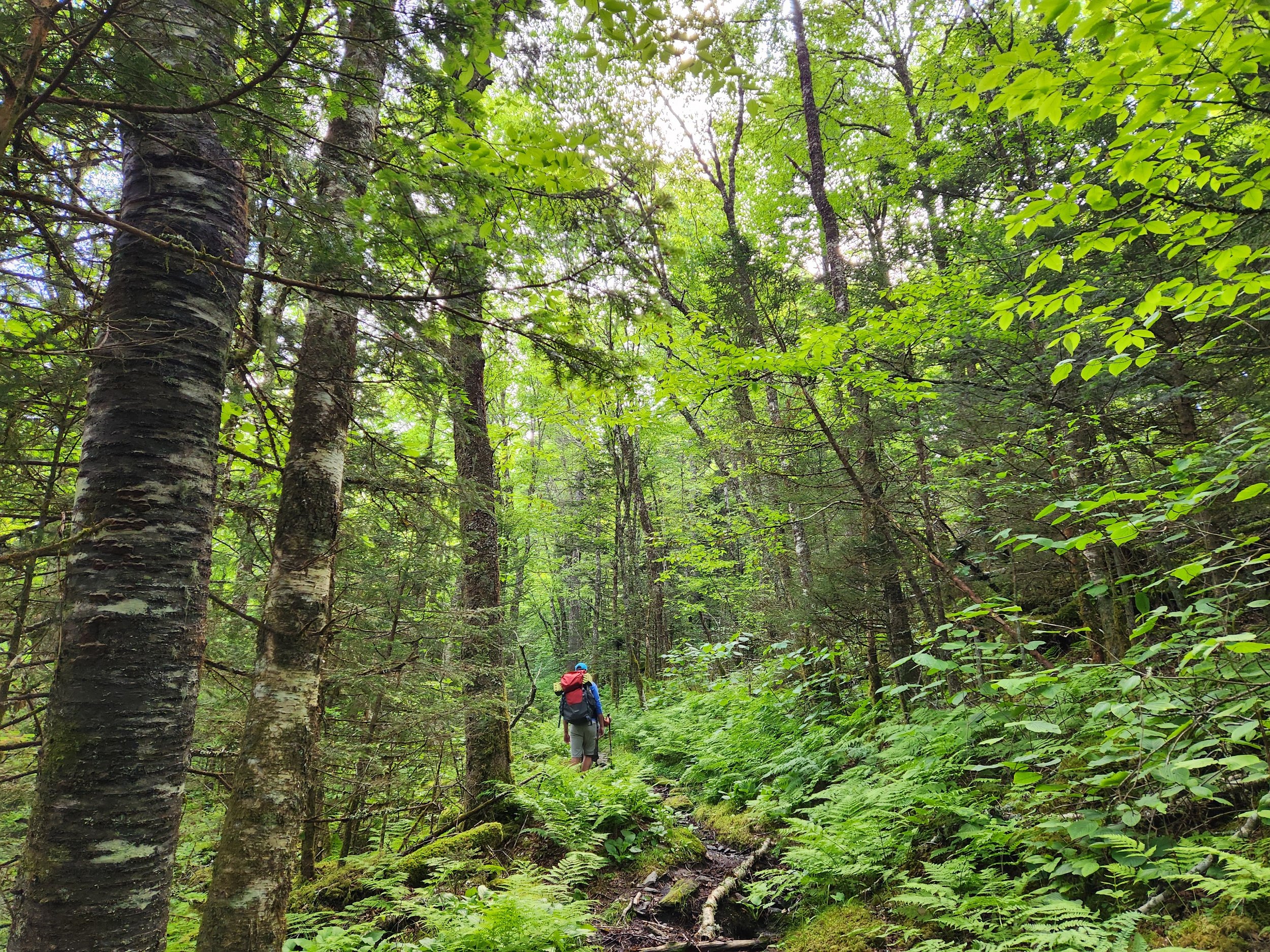
Photo by Lily G
Sure enough, I awoke shortly after 11:00, needing to pee. Fireflies were nowhere near my groggy mind, in which the only thought was, I do not want to leave this tent, but I have to.
Reluctantly, I pulled on my camp shoes and headlamp, in the process making a lucky mistake: I turned on the infrared rather than the white light, so as not to disturb occupants of nearby tents. Although not a good choice for finding my way through the brush, the infrared light, as I would learn later, doesn’t bother the fireflies.
I backed out of the tent, stood up, turned around and … oh. my. goodness. There they were, hundreds or maybe thousands of tiny flashing lights. Maybe there were synchronous flashes, too, but I was too overcome with wonder at the miracle to take in the details.
In the morning we had coffee, tea and/or hot chocolate followed by Francisco’s hot breakfast of eggs scrambled with shredded potatoes, leftover cut-up veggies and cheese to top it off. Then we packed up and got back on trail.
Days 2 and 3 proceeded in much the same way as we continued up the mountain, feeling both the closeness and the expansiveness of the stands of Carolina silverbell, hemlock, beech and tulip trees. By this time we had sorted ourselves into fast and slow subgroups, three in each. Gary liked to stay behind me, ready to help as needed, and I appreciated that and enjoyed his stories of his Michigan life and family.
We had to negotiate several creek crossings where the water was high, with just enough rock about the surface to step and hop across—for the sure-footed, anyway. Francisco provided skilled assistance, especially to me, first ferrying my pack across, then pointing out the best next step and offering me a hand.
The Maddron Bald Trail, built by the Civilian Conservation Corps in the 19302, is “one of the best trails Great Smoky Mountains National Park has to offer,” according to Wildland Trekking’s description. Indeed it is an excellent trail, but the weather can put large obstacles on it overnight. With the tropical storm that blew through the area the week before, dozens of trees had fallen across the trails. Before our group started hiking, the crews had cut through the trees on the lower parts but they hadn’t yet gotten to the upper reaches of the mountain.
We often had to go over, under or around massive tree trunks, and the ways we all helped each other out were an unexpected pleasure of traveling with this group. Plus, Francisco had brought a small hand saw for cutting branches out of the way.
We stayed at the same campsite the second and third nights, which meant that on the morning of Day 3 we didn’t have to take down our tents (yay!) and we carried only supplies for the day. Part of our hike was on the Appalachian Trail, which took us to a clearing where we ate lunch in view of the high peaks of the Great Smokies in the distance.
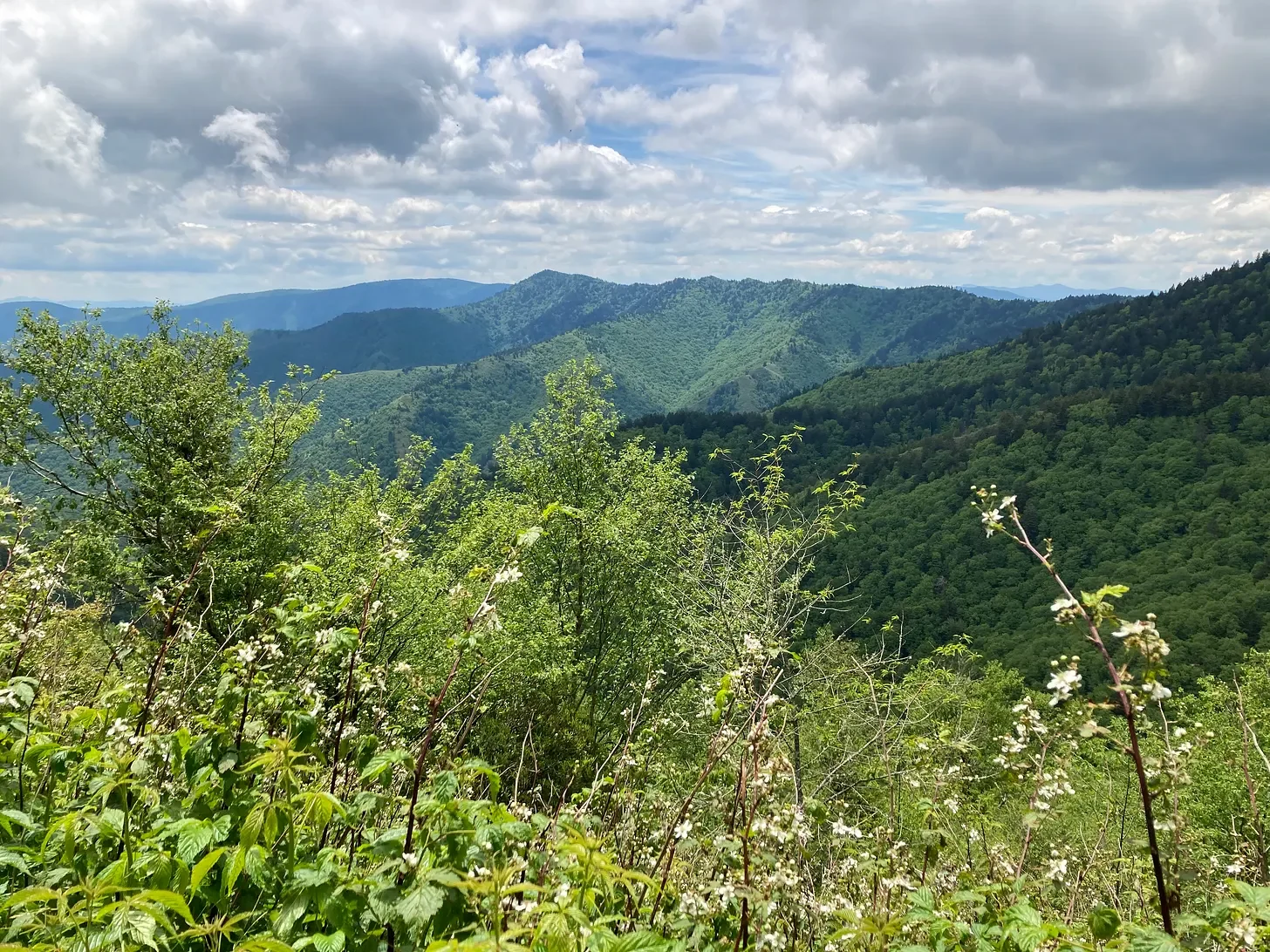
Mountains and wild blackberries
Spending a day on the Appalachian Trail was for me one of the selling points of this trip. The AT fascinates me, as it has done for countless other adventurers. I wonder, could I hike the whole trail? There are many parts of it that I doubt my ability to get through, but in these few days I’ve discovered the power of helpful friends.
On the final day I got up early, packed, enjoyed a quick cup of coffee and then left at 6:30, half an hour before the rest of the group. We had 6.8 miles to hike and a 90-minute drive back to Asheville, and, as the slowest one, I didn’t want to delay our arrival. All the elevation we had gained, about 3,000 feet, we of course had to lose. I’m as slow descending as I am climbing, for different reasons—hiking downhill is hard on the joints.
The others caught up with me after about half an hour. The fast three marched on, and later even the other two in our slow group pulled ahead. I wondered how much faster they might have hiked every day if they hadn’t stayed on pace with me, but the thought didn’t trouble me. “Hike your own hike” is a maxim I’ve finally grown to accept with ease.
I finished the 6.8 miles in almost exactly seven hours. As I walked through the campground parking lot toward the van, one of the fast group came toward me holding a can of La Croix. “There’s lots more,” he said, motioning to the giant cooler parked outside the van. Sure enough, the drinks were still ice-cold, and the “naturally essenced” lime sparkling water was the most delicious thing I’ve tasted, maybe ever.
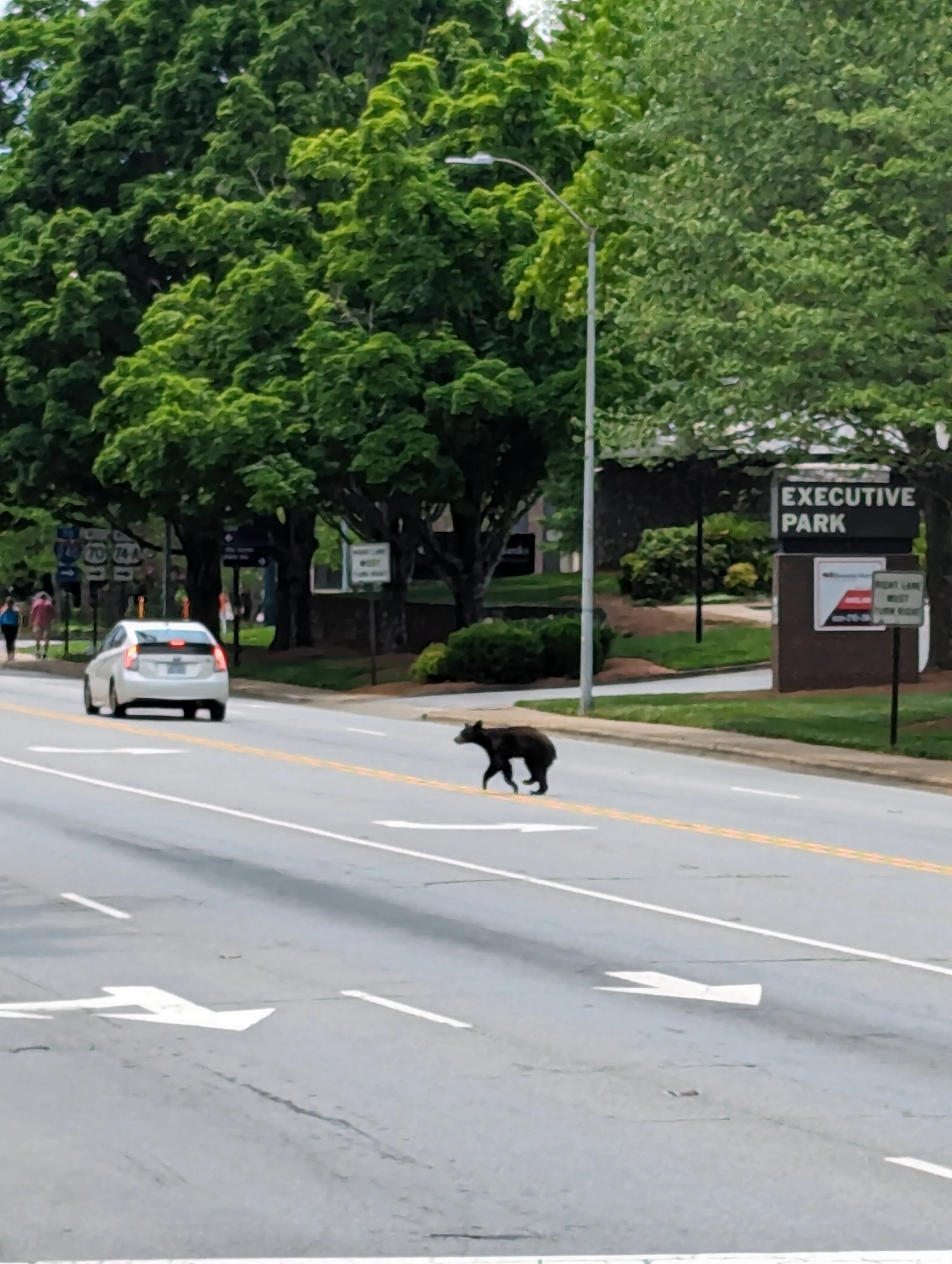
Photo by Dallas G
Francisco brought the sandwich fixings out from the cooler and we enjoyed our final lunch together before the return drive to the city, which had its not-so-delightful parts (roadwork and traffic) and its joys—a shower! a bed! my family coming to spend the weekend with me in Asheville!
One final delight: after four days in the wild with no bear sightings, we finally saw one in town, ambling across the grass near the highway as we approached our hotel. Black bears, common to this area, have been moving from the forests into the human communities, like deer and rabbits where I live. You generally don’t see whole families of bears in town, as we do with the deer and rabbits, but then we don’t have to secure our outdoor garbage cans—only our gardens.
Advice From a Trail
Walk into Beauty
Stay on Your Path
Find Inspiration Around Every Turn
Tread Lightly
Pack Life with Good Memories
Every Day has its Ups and Downs
Watch Your Step!
— Ilan Shamir