Merry May
“O the month of May, the merry month of May,
So frolic, so gay, and so green, so green, so green!
O, and then did I unto my true love say:
Sweet Peg, thou shalt be my summer’s queen!”
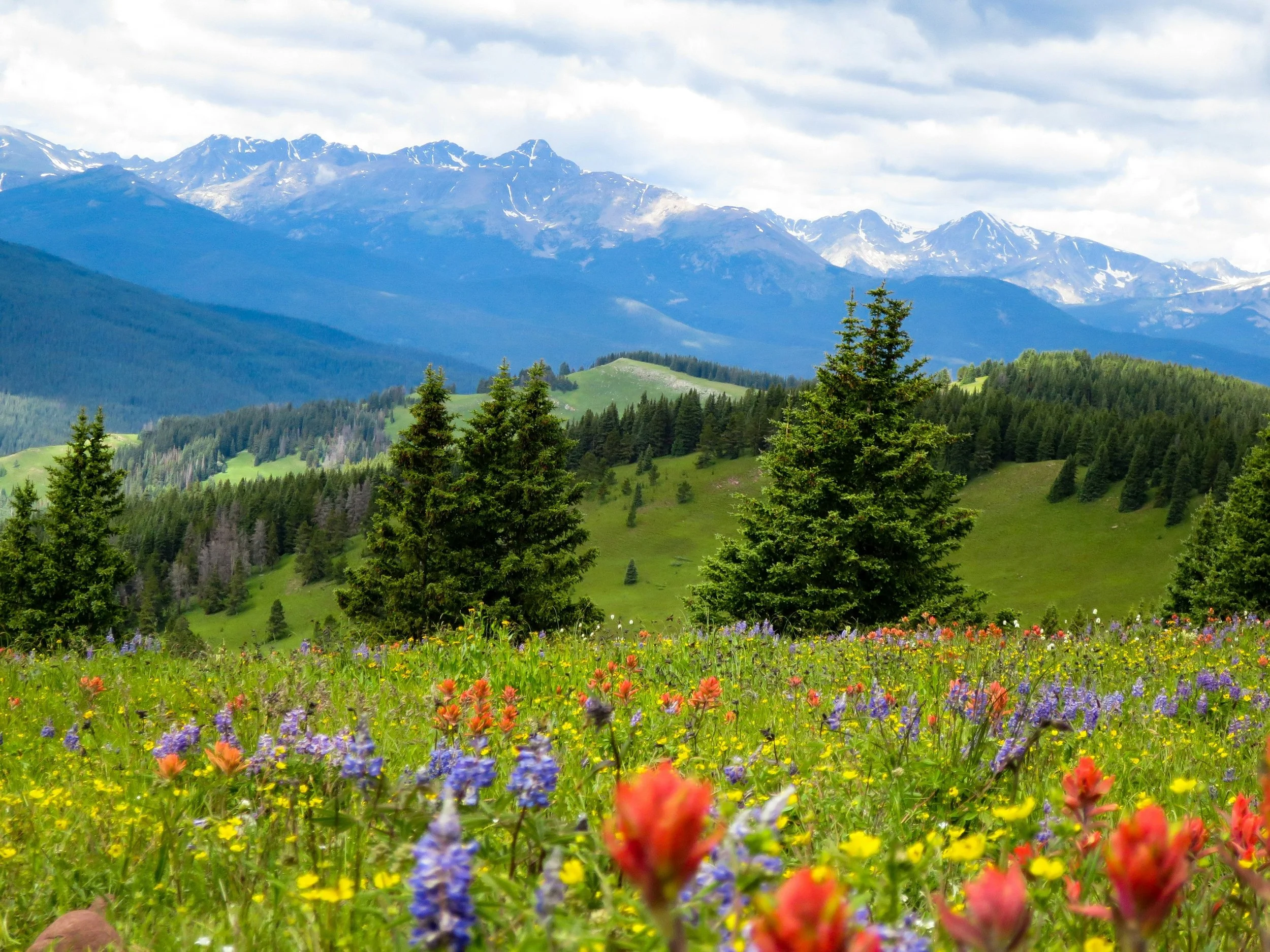
Photo by Courtney Kenady on Unsplash
May 23, 2024
May is galloping ahead, three-quarters gone already, and I’m mostly ignoring it and focusing on June.
My plan for June: Four days of hiking and backpacking in the Great Smoky Mountains
Why: Fulfillment of a dream? Opportunity to learn something about the natural world, of which I am woefully ignorant? Challenging myself to do something new and hard—physically, socially, spiritually?
Question to explore: Is backpacking/camping something I really want to do, or is it just one of those things that I think I should want?
I’ve made a few backpacking trips. In June 2019 I spent two weeks hiking the Appalachian Trail, from Harpers Ferry south to the Big Meadows Campground in Shenandoah National Park, completing just under 100 miles of the AT. A few months later I hiked with a friend for four days, covering another 39 miles in Virginia. We day-hiked from an Airbnb located more or less in the center of our planned AT section. Each morning we drove both of our cars to the endpoint for that day, where we left one car, then drove the other one to the starting point.
A few months later came the pandemic, plus various family needs and other obstacles, all of which kept me mostly off the trails until last summer. In July I day-hiked in several national parks of Arizona and Utah, a planned adventure trip with a few surprises.
Then, last winter a friend told me that she and her partner were planning a June hiking trip in Alaska, which they had booked with a company that operates guided hiking tours in various formats throughout the United States and internationally. I was intrigued.
I hadn’t yet thought about another big hiking adventure, but after studying the offerings I chose a four-day backpacking trip called “High Peaks and Old Growth Forests of the Smokies.” As the trekking company describes it, this trip “combines solitary trails, old growth forests, and some of the most beautiful views in the Smokies in a short, action-packed hike!”
I’ve wanted to see and hike in the Great Smoky Mountains ever since my Dear Son hiked that 72-mile section of the Appalachian Trail right after graduating from high school.
I like the idea of going with a small group (only six of us) and a guide who will teach me something about the mountains, forests, and wildlife, as well as provide risk management, something for which I’ve learned the limits of trusting myself.
This trek has an overall difficulty rating of 3 on a scale from 1 to 5. And there are separate ratings for various aspects, including hiking distances, maximum daily elevation change, and heights exposure. (That last one is rated 1, good news for this acrophobe.)
Another plus: The fee includes all meals and snacks and the use of all the high-quality outdoor gear you want, including backpack, tent, sleeping bag, and sleeping pad. (I plan to use my own gear, except for the sleeping pad.)
And a final, important plus: The company promotes environmental protection and contributes to numerous nonprofit conservation organizations.
So … what’s not to like? Why, as the starting date draws closer (less than three weeks from now), do I feel increasingly anxious about this trip?
Reason No. 1
I’m a very slow hiker. My best city walking pace is just under 20 minutes per mile. This is a good pace for an average walker, but most average walkers don’t have ambitions to hike rugged trails and climb mountains for days on end.
On that two-week backpacking trip in 2019, I learned what it means in real time to hike as slowly as I do. My mileage each day was determined by the distance to the shelter where I would spend the night. The AT has more than 250 of these wooden, lean-to style shelters, most of them near a water source and having a privy nearby. The average distance between shelters is about 8 miles but they can range from 5 to 15 miles apart. On several days I had to hike at least 10 miles to a shelter.
My average pace hiking a moderately difficult trail is 1 mile per hour, even slower on the more rugged and/or steep sections. When I’m hiking by myself this is a problem only for me. On that two-week AT trek there were days when I hiked twelve hours with only a couple of breaks to take off my pack and sit for 15 minutes. There were days when I reached the shelter after dark. The first time that happened, I had to figure out how to hoist my food bag onto the metal bear pole, using an attached pole to lift the bag and slide it onto one of several hooks at the top, 12-plus feet above ground. After dark. By myself, because all the hikers in the shelter were asleep.
But all that was manageable because I believed that I could do pretty much anything, just by pushing myself harder. That particular chutzpah fell apart last summer, but while it was still intact I was unconcerned for my own comfort, overconfident about my safety, and determined to avoid making anyone else go out of their way for me.
With my friend in September 2019, on each of our four hiking days she reached the endpoint at least an hour ahead of me. Fortunately, she was patient and understanding and, after the first day, stashed her work and reading material in the car we had parked there.
A few days ago, worried that my pace would slow down the whole group, I finally called the company’s office and spoke with a helpful woman named Christine, who assured me that most of the hikers on their treks move at about the same pace as mine.
Reason No. 2
Lately my body has been giving me gentle reminders of something I’m just beginning to figure out conceptually: I’m in transition to late life, aging and moving toward … yes, old age.
So far, I’ve been in denial about this, clinging to my denial even while being aware of it. However, in what I might regard as an incidence of synchronicity, I’ve just discovered a book by Connie Zweig, Ph.D., The Inner Work of Age: Shifting from Role to Soul. Zweig writes, “Even if we admit what’s happening, we may compartmentalize this awareness, delaying it for a while: ‘I can’t slow down now, maybe in three years.’ Or we may attempt to bargain with it, cutting a deal to reduce our fear: ‘I’ll exercise harder and longer, and I’ll be okay’” (p. 23).
“Even if we admit what’s happening, we may compartmentalize this awareness, delaying it for a while: “I can’t slow down now, maybe in three years.” Or we may attempt to bargain with it, cutting a deal to reduce our fear: “I’ll exercise harder and longer, and I’ll be okay.”
One thing I love about Zweig’s book is her balanced view of the spectrum of late-life styles and experiences. There are “our fearful images of age—slow drivers who shouldn’t be behind the wheel; people suffering from dementia and left behind in nursing homes; shuffling shoppers pushing their walkers through the grocery store.” She contrasts these images with “another kind of aging that’s happening all around us. Just think: In 2016, a ninety-five-year-old Finnish woman set the record for the world’s oldest woman to complete a 500-foot bungee jump. In early 2019, a 103-year-old woman was sworn in as a junior ranger at the Grand Canyon” (p. 25).
I much prefer the examples in the latter group, and that’s the kind of aging I work to achieve. However, that very phrase “I work to achieve” reveals the fact that I am still very much identified with my ego and, as Zweig puts it, “the ego’s objectives: looking good, feeling in control, getting things done. … The ego’s goals are not the real tasks of late life. Our tasks now require us to move our attention from the exterior world to the interior one, from the ego’s role in society to the soul’s deeper purpose” (p. 39).
“The ego’s goals are not the real tasks of late life. Our tasks now require us to move our attention from the exterior world to the interior one, from the ego’s role in society to the soul’s deeper purpose.”
Zweig’s example of the bargainer makes me squirm, because it is so true of me: “I’ll exercise harder and longer, and I’ll be okay.” But now that she has got my attention—by “telling the whole truth,” the subhead of her section titled “What Is ‘Old’?” (p. 25)—I’m learning from her that the “inner work” of aging begins with accepting this transition in my life and understanding that this work is mine to do, influenced but not determined by any of the myriad factors at play, including my genetics, disposition, physical and mental health, financial and social resources, and privilege.
Photo by Sebastian Unrau on Unsplash
Whatever shape our path takes, each of us who are blessed with many years of life will encounter the “divine messengers”—a term Zweig takes from the Buddhist tale of the awakening of Siddhartha Gautama, the Buddha, to the truths of life. The “divine messengers” are illness, old age, and death.
My body has chosen this inconvenient time, less than three weeks out from a major physical challenge, to send one of those “divine messengers” to my gut—the center of emotion and instinct and the residence of 100 trillion microbes that affect my life in every possible way, from my metabolism to my immune system to my overall moods and momentary emotional reactions.
When I was growing up, “listening to your gut” was viewed as metaphorical, while the “real” function of the digestive system was only physical. As a young adolescent, I had no idea that the sensation of my stomach suddenly dropping when I saw the boy I was infatuated with was an emotional message from my brain, and that I ought to give it some rational thought. Nowadays, the brain-gut connection is one of the hottest areas of scientific research.
I won’t go into the particular expressions of my gut’s present communication (maybe a topic for a future post) but the message is clear: something needs to change. So I’ve been experimenting with dietary restrictions (results inconclusive, so far) and addressing my need for better stress management.
The small changes I’m making, including an earlier bedtime and rededication to 20 minutes of meditation daily, are practices of slowing down—a big change that is hard for me to accept but, according to Zweig, a necessary condition for late-life growth and flourishing. Zweig writes (p. 30):
“The Latin root of the word old, alere, means “nourish.” Somehow, in our postmodern, youth-oriented society, the precious, ancient meaning of Old, whether it’s “nourished” or “nourishing,” has vanished. My prayer would be that Elders are both.”
One way I can slow down and, as a bonus, interrupt this month’s gallop toward oblivion, is by calling myself to presence in the moment. Then I can notice and take delight in the magic of May: the choral symphony of birds that greets me as I walk outdoors in the early morning; the scent of freshly mown grass; the feel of the soft, rich soil yielding the roots of weeds to my pull, and moving with the spade to receive the tomato, pepper, and marigold plants that my Dear Husband and I put in yesterday.
For Old Age
May the light of your soul mind you.

May all your worry and anxiousness about your age
Be transfigured.

May you be given wisdom for the eyes of your soul
To see this as a time of gracious harvesting.
May you have the passion to heal what has hurt you,
And allow it to come closer and become one
     with you.

May you have great dignity,
And a sense of how free you are,
Above all, may you be given the wonderful gift
Of meeting the eternal light that is within you.

May you be blessed;
And may you find a wonderful love
In your self for your self.

John O'Donohue, from To Bless the Space Between Us