Learning to Look Again
January 22, 2024
I don’t remember how I discovered DrawTogether with WendyMac, the Substack by New York Times bestselling artist Wendy MacNaughton. It was toward the end of last year and the 30-Day Drawing Habit offered in January seemed exactly right for me, so I signed up.
I already wanted to learn to draw. Occasionally over the past several years I’ve purchased supplies — sketchbooks, colored pencils, markers, and even a set of fancy graphite pencils from Artist’s Loft — but made little progress toward actually drawing.
WendyMac’s 30-Day Drawing Habit, as she describes it, “introduces the life-changing, world-transforming power of daily drawing (and painting, doodling, and general making) into your life. It will also give you the tools to maintain a practice long after the 30 days.” The 30-day program is part of her DrawTogether community, the Grown-Ups Table (aka, The GUT), where, she says, “you’ll meet other like-minded creative folks from all backgrounds and skill levels and receive tremendous encouragement, accountability, and community.”
Each day this month, we get an email with a brief art lesson and a 10-minute drawing prompt. I’ve not yet shared any of my drawings in the GUT, but I’ll share a few of my notes here.
First, some background: I started first grade at a public school in Phoenix in 1961. Mixed in with the daily academic schedule were the “specials,” as they’re called now. They were, and in some public schools still are, art, music, and P.E., each once a week. At my school there was an art teacher for grades 1 through 3 and another one for grades 4 through 8. (Middle school wasn’t yet a thing in Phoenix, though our grades 6 through 8 had a middle-school-like class schedule.)
I don’t remember my first art teacher’s name, but she looked like Hilary Knight’s illustrations of Mrs. Piggle-Wiggle — short, plump, cheerful, her gray hair pulled back in a messy bun. Each year in spring, she held an open house at her home, and she chose three girls from her art classes to attend as tiny hostesses. Her large, ranch-style house was formally decorated with plush carpets, ornate furniture, and delicate china figurines on shelves. Each room featured a different color palette — red, green, or blue. The year I was part of the privileged crew, I was assigned to the blue room and had to wear a pastel blue, church-worthy dress.
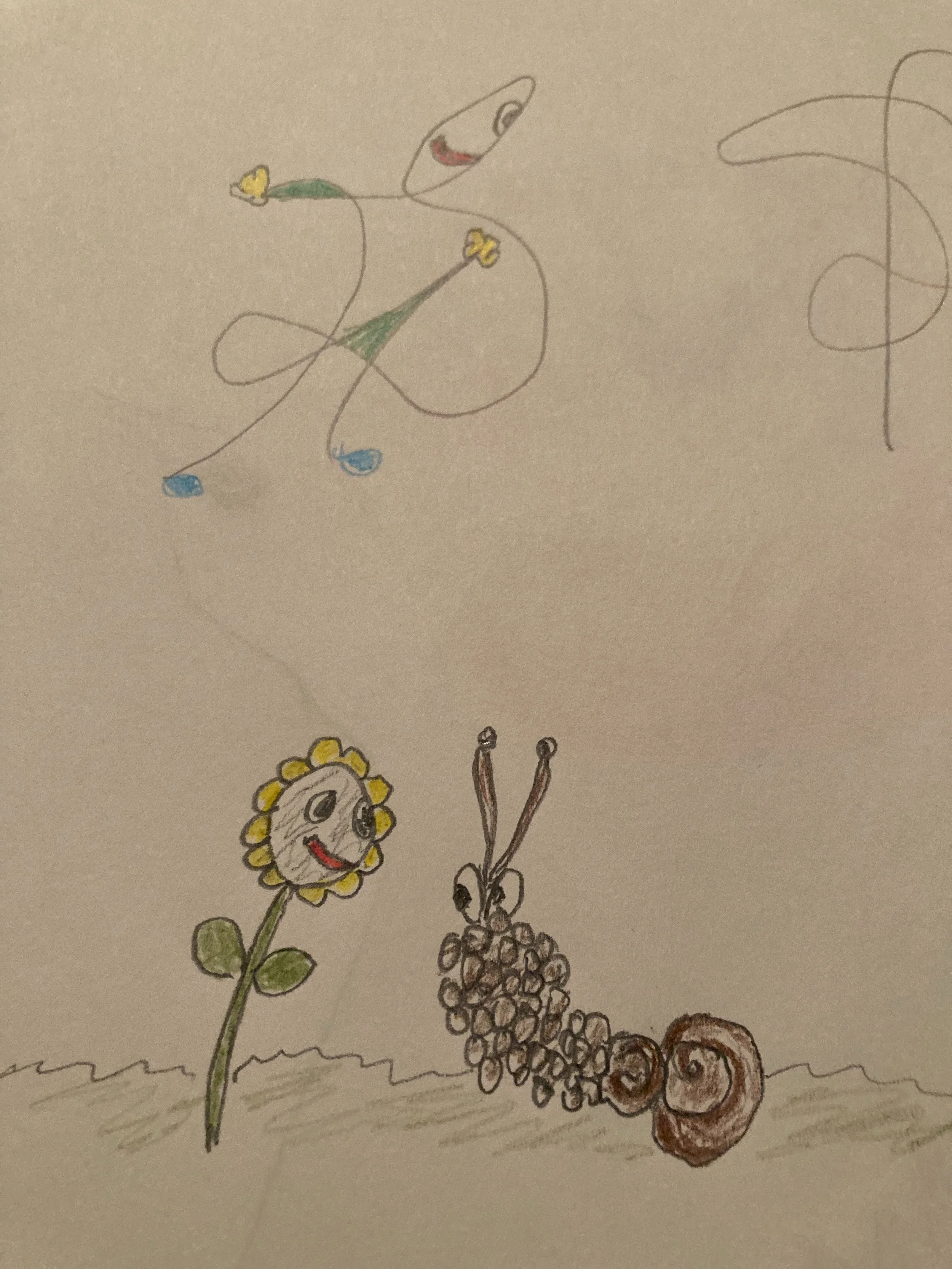
The Doi circles copy and, above it, my original doodle art
The only thing I remember from art classes was that the teacher would pass out sheets of 9x12-inch construction paper and we were to use our rulers to measure one inch in from each of two adjacent sides of the paper, draw a line across the width and another down the length, then with scissors carefully cut off the two segments.
“An eech off the top, and an eench off one side,” she instructed, her accent strange and interesting to my ear. I don’t know why she wanted our papers to be 8x11 inches, maybe in order to fit into a binder. I never asked.
Then came fourth grade and Mrs. Chaudrey, the upper-grades art teacher, the only elementary school teacher I remember as mean. Not that I have any evidence. It’s possible that I had absorbed my older brother’s opinion and passed judgment on Mrs. Chaudrey before meeting her. She had a reputation among the kids for being mean, so from the start I felt anxious, out of place, and incompetent in her class.
The next year, in fifth grade, I had an extra music class, a small-group clarinet lesson, for which I was excused from art, to my relief and joy.
DrawTogether
The first week of DrawTogether was mostly about doodling in a variety of styles. I enjoyed it as I felt myself relax into the process, relieved of the fear of having to draw any thing that was supposed to look like something. That part came on Day 6. Doodle Finale! — when the assignment was to play The Doodle Game! I hate most games anyway, and the idea of playing any sort of a game with art gave me a stomachache.
Here’s the game: Choose one of the doodle styles introduced in the previous days. Doodle in that style for 2 minutes. Then, make something out of it. Or, in WendyMac’s words,
Look at the whole image you’ve created on the page with your doodle. What shapes or stories emerge? Are there figures? Feelings? Now complete the drawing!
I froze, completely stuck in my judgmental head, certain that I could never imagine a thing and then draw it. Underneath the instructions were a couple of examples, one of which I simply copied, starting with WendyMac’s chosen doodle style of Doi circles. I had to draw something for another 8 minutes, and copying was the only way I could make my hand move.
However, making the completely unoriginal copy did thaw my brain, at least a little. The first part of the assignment was to draw three random doodles or scribbles. These were on my page, above the doodle drawing I had copied. So I looked at them carefully and then, on one of them, drew a face, added little shapes for hands and feet, colored these plus parts of the doodle for arms. It’s bizarre and amusing and recognizably human-ish.
Then came Week 2. Drawing Delights!
Every day I will give you a general ”Delight Topic” to start you off, and if you have a different sort of delight you want to draw that day, DO THAT. No rules in art. You do you. — WendyMac, Day 7
She emphasizes and often repeats that one rule: No rules in art. You do you.
However, it was not good news for me, that Week 2 was about delight. I was feeling far too unsure of myself in the world of drawing to regard anything as delightful. At the end of each daily email there are several examples of GUT members’ drawings from the day before. I found these intimidating; apparently, “all skill levels” didn’t include my level, which is total-beginner-I-don’t-know-how-to-draw-anything. Even though WendyMac also often assures, “Everyone can draw.”
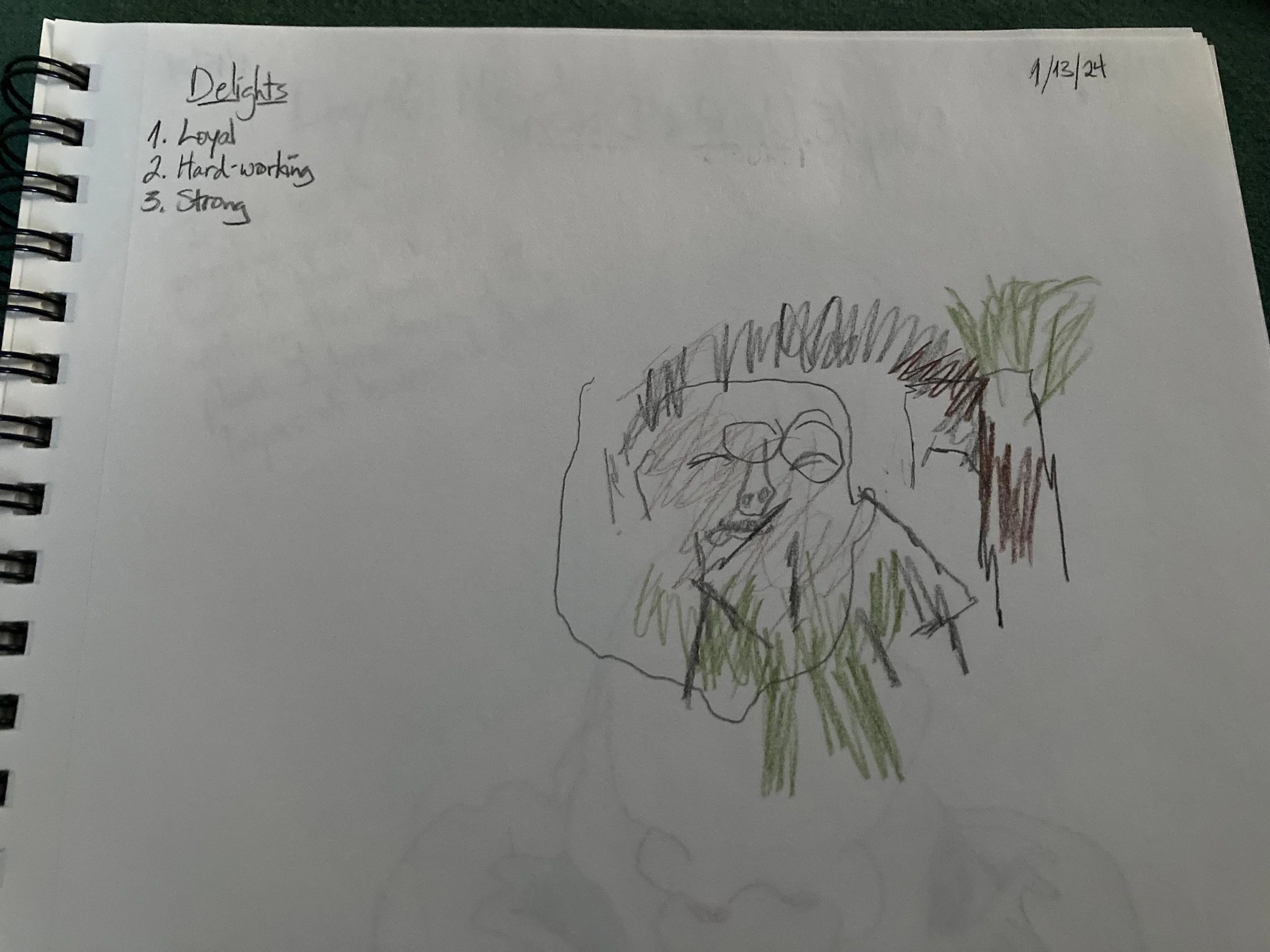
My un-delightful, blind contour self-portrait
The first two days of the Week of Delight weren’t bad. The assignment for Day 7 was to draw any object that brings me delight and, because it was late and I was tired, I copied a bird with wings outspread, part of the cover art of a little notebook that delights me. My slow, meticulous copying didn’t get me very far in 10 minutes, so I returned to continue this drawing on a few days when the assignment was more than I could face.
Day 8’s assignment was to draw a delightful food. I felt comfortable, if not exactly delighted, drawing the apple I placed in front of me, and seeing that my drawing wasn’t terrible. Then I had a small breakthrough on Day 9, drawing a spider plant. I noted on the page, “I actually made one leaf that looks like it’s in front of the pot” — perspective, woohoo! And, progress that felt more significant: toward the end of the 10 minutes, “I began to just draw instead of meticulously copying.”
Day 10. Delight: Blind Contour Drawing
The instructions were to choose a subject — some object or a person — and draw the subject without ever looking down at my paper. I was supposed to keep my eyes on the subject and “imagine [my] eyes and pen are connected.” As soon as I put pencil to paper, I felt so much resistance to this assignment that I could not follow its one rule: never look down at the paper. How does anyone DO this?! Whenever I had to pick up the pencil, I had no idea where to put it down again.
The real lesson was about delighting in the process of drawing, but it took me several days to let that sink in. It didn’t help that all the examples, from WendyMac’s blind-contour Winnie the Pooh to GUT members’ postings in the chat, shown at the bottom of the next day’s email, all looked discouragingly close to perfect.
Day 11 was one of those days when I returned to my unfinished bird in flight. On Day 12 I drew things from my imagination, representing the five senses. I drew them quickly, to get it over with, and my triumph was that I actually finished the drawing in 10 minutes. The assignment for Day 13 was a blind-contour self-portrait, to be drawn after first writing down three of my most delightful qualities. I could not think of any, so I wrote “loyal, hard-working, and strong” — not exactly evoking delight.
The next few days were easier, as I was able to copy models or objects. Relaxing a bit, I began to notice what I saw, such as the delicate lines fanning out from the middle of a philodendron leaf. Drawing them made my leaves look more like leaves.
Thus encouraged, I approached …
Day 14. Let’s get weird.
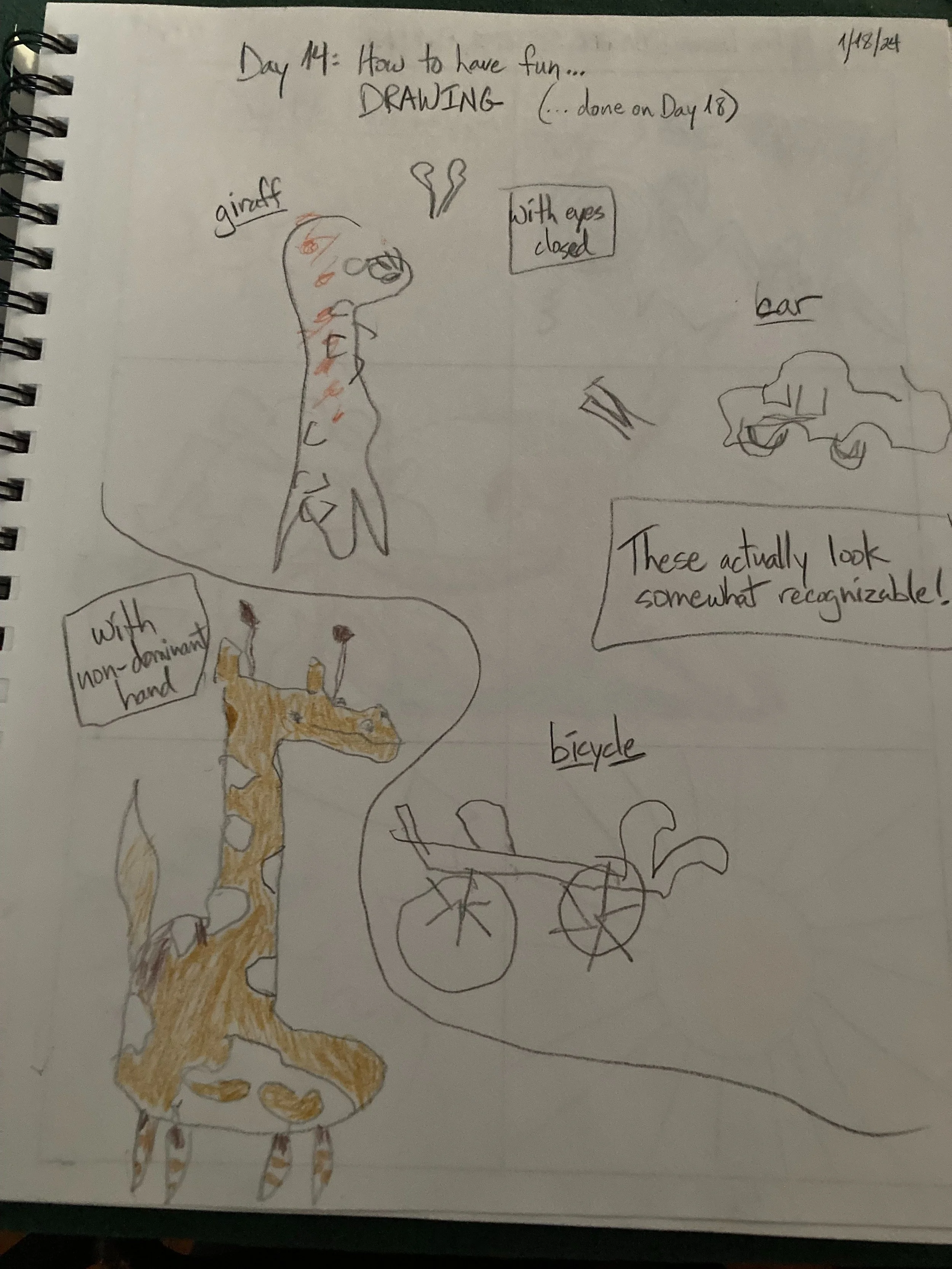
There were two exercises: 1. Draw with your eyes closed, and 2. Draw with your non-dominant hand. For the first, I was to draw a giraffe, a car, and a bicycle, for one minute each, eyes closed. Then, take two minutes to draw a giraffe with my non-dominant hand. I put my inner critic in time-out and proceeded.
The result surprised me — not that any of my drawings looked good (I had dropped that expectation) but that they were recognizable, as giraffe, car, and bicycle, which I found … delightful.
“We have a lot of different levels of experience and confidence at the GUT. It’s one of the great things about us - we learn from each other and support each other, no matter where we’re at. Give yourself the gift of feeling supported.”
Today I visited the GUT chat for the first time. I scrolled through the drawings members had posted for Day 10, blind contour drawing, and Day 14, those giraffes, etc., with eyes closed. I was pleased to see drawings that looked more like mine — a giraffe’s spots flying outside its body, scribbled cars and bicycles with tires floating in space.
And I took delight in reading the comments from so many members who felt joyful, playful, and powerful and had FUN with their drawings. I totally agreed with one person who wrote about the non-dominant-hand giraffe, “It probably better resembles a giraffe than anything I could muster with my [dominant] hand.”
In the Day 7 email, WendyMac includes the link to her wonderful TED talk, “The art of paying attention.” She gives the audience a blind-contour drawing assignment (for less than a minute), which she introduces as “a little trick to rewire your brain into looking again.”
As I do these 10-minute assignments each day, I practice WendyMac’s instruction to “go slow, pay attention, and draw what you see.” As I slow down and see more, I want to keep looking and to expand my field of vision. As I let go of my perfectionism and judgment (or have them pried out of my fists), I begin to have FUN — which is the theme of this week’s lessons.